News & Articles Facts About Flying Fears Flying Weather Conditions Flying in Turbulence and Bad Weather Many people are scared to fly because they are fearful of flying in turbulence and bad flying weather conditions. 
Whilst disturbances in the weather are a very natural phenomena, they can feel very unnatural to passengers in an aircraft cabin at 36,000 feet. Turbulence is simply an irregular flow of air that often occurs unexpectedly and usually cannot be seen. It is caused by a variety of conditions: -
flying in the vicinity of thunderstorms -
flying through cloud -
flying over mountains -
flying at high altitude near to jet streams -
flying in or close to a weather front -
flying between air masses of differing temperatures 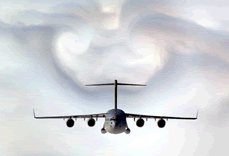
The degree of turbulence is described by a numerical identifier or a descriptive word -
light (1) -
moderate (3) -
severe (5) - extreme (6)
Common Misconceptions It is not called an air pocket and, despite sensational reports to the contrary, with the use of modern autopilots, aircraft do not drop through the sky when they encounter turbulence. 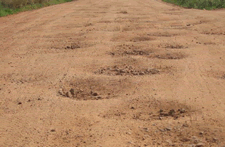
Flying in turbulence is no more dangerous than driving along a bumpy road. No-one can deny that it can be uncomfortable but it will not cause damage to the aircraft and the only way it can possibly cause harm to passengers or crew is if they insist on walking around the cabin and risk stumbling or falling. You will find that pilots will switch on the fasten seat belt sign if they are expecting or experiencing turbulence on the flight. This is for your comfort as well as for your safety. Pilots liaise with each other, through air traffic control centres, to report turbulence as this helps with flight planning. Flight routes can be altered to avoid bad weather, if necessary. No-one, passengers or crew, wants a bumpy ride. Pilots will almost always do their best to warn passengers if they expect to be flying in turbulence if it cannot be avoided. Whilst it may be easy to route around turbulence in midair, it is not so easy if the weather at the take off or landing airport is not so good. If weather conditions are unsuitable for either
take off or landing the pilot will not attempt either.
It is as simple as that. For more information on flying weather conditions
in the UK click here... | Flying Weather Conditions - Weather Check You may have heard about clear air turbulence or CAT which occurs in clear air and cannot be picked up by weather radar, although pilots and forecasters can usually identify likely areas of CAT by inspecting weather charts. 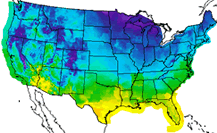
If you are going to be flying in or around the USA
you can check yourself to see if you are
likely to be flying in turbulence. Take Off Flying Weather Conditions For take off a consideration will be the component of the wind that is blowing across, rather than down, the runway the crosswind factor. 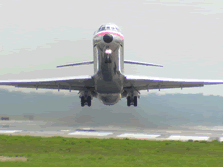
All aircraft have a certified maximum cross wind limit in which they are cleared to take off or land. In a light aircraft this may be as little as 15knots for an airliner it is as much as 45 knots. In the unlikely event that the wind is outside the documented limits the flight will be delayed or cancelled. Landing Flying Weather Conditions For landing, there are also cross wind limits and these may vary depending on the landing technique to be employed and also on the runway conditions. 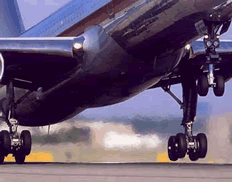
If the weather is outside limits at the destination the pilot will either hold, if the forecast suggests an imminent improvement, or divert. The pilot will not operate the aircraft outside the documented limits. Aircraft Structure in Bad Flying Weather Conditions You may be wondering about the structure of the aircraft flying in turbulence?
When aircraft are air tested they are stressed to an extent that it is almost impossible to replicate in flight. 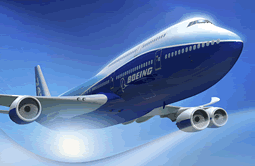
There is no possibility of parts of the airframe being broken off by extreme weather. If an aircraft does encounter severe turbulence the pilot will report this fact when landing and the aircraft will be checked by an engineer before it next flies. Safety is the first priority of all airlines. Pilot Priorities in Bad Flying Weather Conditions On the subject of priorities, be aware that the pilot will always put his duties of flying the aircraft first and foremost. If, in bad weather conditions, there is no news from the flight deck do not assume the worst. Try to relate it to your experiences of driving in bad weather do you converse with your passengers or do you concentrate on the road? As soon as the workload in the cockpit diminishes your pilot will talk to you and let you know what is going on. I hope that by telling you more about flying in turbulence and its effect on the aircraft and flights, you discover that knowledge begins to diminish fear. Never forget that the pilot wants to get home to his loved ones too
this particular pilot has a young son and wife to whom he likes to return each evening. |